
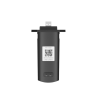


This kit includes 6 glasses of 2V, already ready for use in 12V installations (for installations of 24V 2 KITS will be necessary).
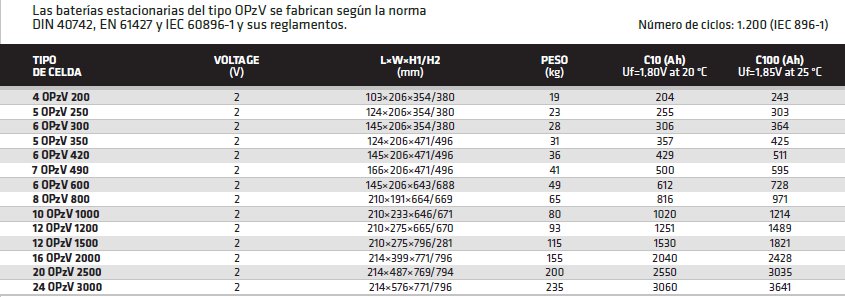
It combines the benefits of recombination technology (virtually maintenance-free due to its very low gas emissions) as well as the advantages of conventional open cell batteries with positive tubular plates (long life and excellent cyclability). Capacity: 303Ah (in C100) and 255Ah (in C10). Operative life of more than 15 years.

Secure payment

Shipping policy

Return policy
The OPzV range of lead acid has been specifically developed for applications in photovoltaic solar energy systems.
These individual 2 V cells or elements are optimized for high cycle reliability, high reliability and low maintenance.
Tz OPzV batteries are a very balanced combination of features that makes OPzV batteries the ideal solution for many of the most demanding applications, and above all, for automatic or remote installations where the level of efficiency and reliability is very demanding.
The design combines a Valve Regulated Lead Acid (VRLA) technology with high performance tubular positive plates for an extraordinary combination of advantages (long life and excellent capacity cycles).
VRLA technology has been enhanced to support the repeated and durable discharge of cells and blocks that are used for solar energy storage, avoiding the loss of water associated with conventional lead-acid batteries. The use of a gel electrolyte means that the cell does not contain free acid, so it can operate horizontally and vertically, and can be transported reliably without risk of spillage.
Positive tubular plates are widely used in batteries for very demanding cyclic applications. This robust structure has been incorporated into the OPzV design to meet the low maintenance features of VRLA technology.
The container and its covers are manufactured Made of plastic (ABS). It is also available in ABS fireproof material as an option (according to IEC 707 FV0).
Terminals are M10 and are sealed, allow perfect contact and low resistance with flexible cable connectors, avoiding acid leakage and corrosion at the terminals.
Flexible connectors, Cable connectors, fully insulated and screwed (with 20 ± 1 Nm) to the terminal with an insulated screw having a hole in the top of the probe for electrical measurement
This relief valve opens at low pressure and is equipped with a device to avoid flames of fire.
Positive tubular plates are widely used in batteries for very demanding cyclic operation applications. This robust structure has been incorporated into the OPzV design to meet the low maintenance features of VRLA technology.
The container and its covers are manufactured Made of plastic (ABS). It is also available in ABS fireproof material as an option (according to IEC 707 FV0).
Terminals are M10 and are sealed, allow perfect contact and low resistance with flexible cable connectors, avoiding acid leakage and corrosion at the terminals.
Flexible connectors, Cable connectors, fully insulated and screwed (with 20 ± 1 Nm) to the terminal with an insulated screw having a hole in the top of the probe for electrical measurement
This relief valve opens at low pressure and is equipped with a device to avoid flames of fire.
Structure
Positive electrode: Tubular plate with lead-tin-calcium alloy.
Negative electrode: Flat plate with lead-calcium alloy grid.
Separators: Microporous material of low resistance.
Housing and cover: Finished in acrylonitrile butadiene styrene (ABS), available with optional flame retardant ABS (UL94 V-0).
Electrolyte: Gel-like immobilized sulfuric acid.
Terminals: With brass inserts and stainless steel M10 bolts. Color washers for simple polarity detection.
Each connector design is bolt-on type and allows voltage measurements.
Pressure Relief Valve: One-way valve with flame lock.
OPzV Batteries are manufactured according to Standards:
+ In accordance with international standard EN 60896-1.
+ In accordance with international standard IEC 60896-1 / 2.
+ In accordance with the international standard IEC 896-1.
+ In accordance with international standard EN 61427.
+ Low ventilation requirements in accordance with EN 50272-2.
+ Conforms to DIN 40742.
+ Made in TAB Batteries production plants with ISO 9001, ISO 14001 and ISO 16949 certification.
The batteries can be connected between them by forming three different types of connection:
Serial connection:

The serial connection is made when you want to increase the voltage while the capacity of the battery is maintained. To make this type of connection, you must attach the positive pole of one of the batteries, with the negative pole of the other.
Parallel connection:
The parallel connection serves to multiply the capacity of the battery while the voltage remains constant. To do this, all the positives are connected on one side and on the other side, all the negative poles.
Mixed serial and parallel connection:
This type of connection is made in installations at 24V where you want to connect more than 2 batteries at a time. In this case, batteries should always be placed in pairs, ie in pairs. It is not recommended to connect more than 8 12V batteries to each other, as this may damage the installation because of performance losses.
Attention: Never connect the positive and negative poles of the same battery together. This will result in a short circuit and irreparable damage to the battery. Also do not connect several batteries in a circle, for the same reason.
The most important cables of a solar installation are those that are used to connect the batteries to each other and the one that connects from the battery to the inverter. These cables must be sufficiently sectioned.

This kit includes 6 glasses of 2V, already ready for use in 12V installations (for installations of 24V 2 KITS will be necessary).
It combines the benefits of recombination technology (virtually maintenance-free due to its very low gas emissions) as well as the advantages of conventional open cell batteries with positive tubular plates (long life and excellent cyclability). Capacity: 303Ah (in C100) and 255Ah (in C10). Operative life of more than 15 years.