
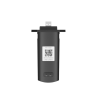



Deep charge solar battery
This kit includes 6 vessels of 2V, ready for it use in installations of 12V (for installations of 24V it will be needed 12 vessels)
It has a capacity of 380Ah (C100) and 259Ah (C10) and an average shelf time up to 20 years. It is perfect for continuous cycles of charging and discharging at houses of daily use. 1500 cycles.

Secure payment

Shipping policy

Return policy
TAB OPzS stationary batteries are manufactured with conventional lead-acid technology.
Dry Charged: The battery has to be charged before use (diluted sulfuric acid density 1.24kg / l @ 20ºC). The plates are already formed and in a special process protected against oxidation. They can be stored without problems.
Charged electrolytically (activated): The battery can be installed immediately, as they are already charged with the electrolyte and charged electrically. The capacity test has been performed by the manufacturer.
Structure
Positive electrode: Tubular plate with lead-calcium alloy.
Negative electrode: Flat plate with lead-calcium alloy grid.
Separators: Microporous material of low resistance.
Housing and cover: Finished in SAN, cover in ABS in gray.
Electrolyte: Diluted sulfuric acid density 1.24kg / l @ 20ºC.
Terminals: With brass inserts and stainless steel M10 bolts.
Color washers for simple polarity detection.
Elements in 2V, 4V, 6V, 8V and 10V.
Ceramic plugs according to DIN 40740.
Long-life flooded tubular plate batteries.
Shelf life:> 20 years at 20ºC,> 10 years at 30ºC,> 5 years at 40ºC.
Number of possible cycles: more than 1,500 cycles at 80% discharge.
Under maintenance.
Under normal operating conditions and at 20 ° C, distilled water should be added every 2-3 years.
Uses and applications
Stationary batteries of the OPsZ type are designed for the supply of renewable energy installations, solar photovoltaic systems, low eolic power, hybrid installations, pumping systems, rural electrification, telecommunications and signaling, computers, emergency lighting, alarms, Control and monitoring in power stations and distribution centers, in stations, airports, transport and maritime navigation, etc.
OPzS Batteries are manufactured according to Standards:
+ In accordance with international standard EN 60896.
+ In accordance with the international standard IEC 896-1.
+ In accordance with international standard EN 61427.
+ Low ventilation requirements in accordance with EN 50272-2.
+ In accordance with DIN 40736.
+ In accordance with international standard DIN 40737 part 1.
+ In accordance with international standard VDE 0510 part 2.
+ In accordance with DIN 40736.
+ Made in TAB Batteries production plants with ISO 9001, ISO 14001 and ISO 16949 certification.
The batteries can be connected between them by forming three different types of connection:
Serial connection:

The serial connection is made when you want to increase the voltage while the capacity of the battery is maintained. To make this type of connection, you must attach the positive pole of one of the batteries, with the negative pole of the other.
Parallel connection:
The parallel connection serves to multiply the capacity of the battery while the voltage remains constant. To do this, all the positives are connected on one side and on the other side, all the negative poles.
Mixed serial and parallel connection:
This type of connection is made in installations at 24V where you want to connect more than 2 batteries at a time. In this case, batteries should always be placed in pairs, ie in pairs. It is not recommended to connect more than 8 12V batteries to each other, as this may damage the installation because of performance losses.
Attention: Never connect the positive and negative poles of the same battery together. This will result in a short circuit and irreparable damage to the battery. Also do not connect several batteries in a circle, for the same reason.
The most important cables of a solar installation are those that are used to connect the batteries to each other and the one that connects from the battery to the inverter. These cables must be sufficiently sectioned.

Deep charge solar battery
This kit includes 6 vessels of 2V, ready for it use in installations of 12V (for installations of 24V it will be needed 12 vessels)
It has a capacity of 380Ah (C100) and 259Ah (C10) and an average shelf time up to 20 years. It is perfect for continuous cycles of charging and discharging at houses of daily use. 1500 cycles.